
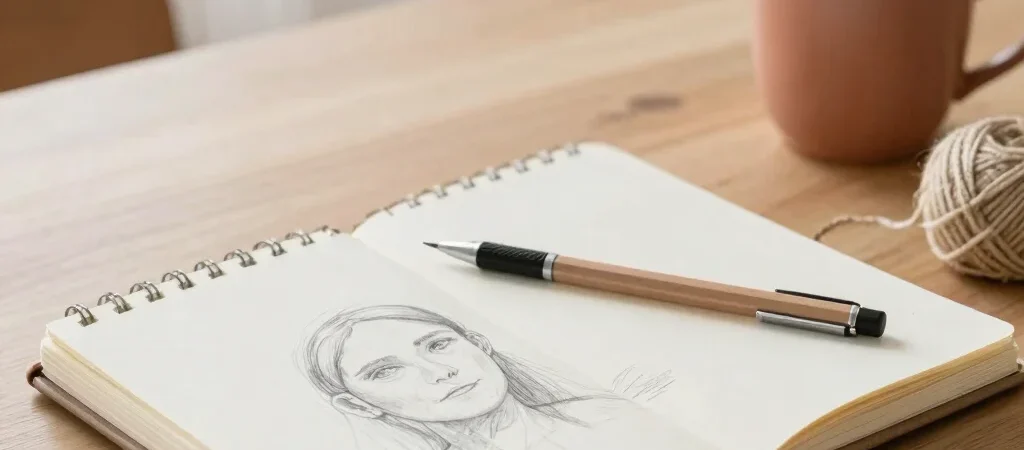
There is a particular pleasure in finishing a page by hand and seeing the ink stay there. Analog hobbies—from sketching and knitting to keeping a paper journal—make the process tangible in a way a scrolling feed rarely does. Their appeal is not that screens are bad; it is that some kinds of attention feel better when they have a boundary.
Choose an activity with edges
A crossword has a grid, a knitting project has rows, and a sketchbook has pages. That visible shape makes it easier to begin without deciding what to do every few seconds. You can put the materials away when you are done, and the activity does not automatically open into another stream of content.
Start with something small enough to fit into an ordinary evening. Keep a pencil and a few sheets of paper near the couch, or try a simple mending job on a button that has come loose. The point is not to become an expert or buy a full set of equipment; it is to make starting easy.
Let the result be imperfect
A first sketch may look awkward, and a hand-sewn repair may show its stitches. That is part of the exchange: you get a finished, physical trace of time spent, not a polished performance for an audience. Treating the hobby as practice rather than content can make it easier to return to.
If you want to try one, borrow tools or use what is already at home before buying more. Set aside twenty minutes, silence alerts if they tend to pull you away, and choose a task with a clear stopping point. A hobby does not need to transform your routine; it just needs to give your attention somewhere satisfying to land.